
We're Hiring!



Plainfield has grown significantly along the I-70 corridor in Hendricks County, and much of its residential housing was developed during a concentrated period in the late 1990s and 2000s. That means a large share of local furnaces were installed around the same time and are now aging through the same failure window together. Complete Comfort Heating, Air & Plumbing serves Plainfield homeowners with furnace repair that identifies the actual cause of a problem and addresses it correctly rather than cycling through parts until something works.
We offer 24/7 emergency furnace service throughout Hendricks County because a cold night in Plainfield does not care that it is a weekend or a holiday.
In Plainfield’s newer housing stock, furnace warning signs can be subtle because tightly built homes mask reduced output longer than drafty older construction. By the time a symptom becomes obvious, the underlying problem has usually been developing for at least one full season. Do not wait on these indicators.
Hendricks County’s hard water is a factor that connects several of these symptoms in high-efficiency furnaces, and recognizing the pattern early makes for a simpler fix than waiting until a full lockout forces the issue.

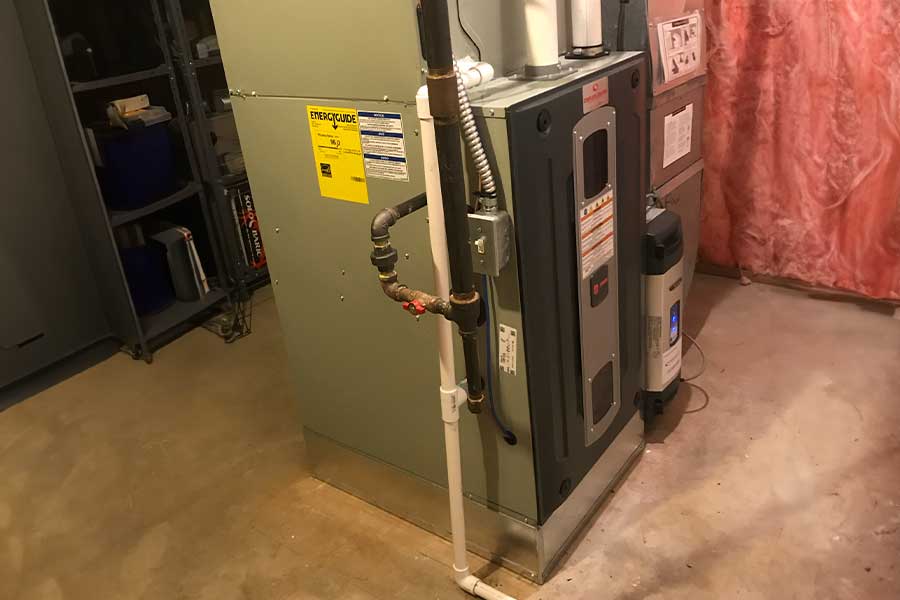
The story of furnace repair in Plainfield runs through two overlapping realities. First, the concentrated development era of the late 1990s and 2000s means thousands of local furnaces are aging through their component wear window at the same time, creating demand for the specific failure modes common to that generation of equipment. Hot surface ignitors, secondary heat exchanger surfaces, pressure switch calibration drift, and variable-speed blower motor capacitors are all reaching their natural service limits across Plainfield neighborhoods simultaneously.
Second, Hendricks County’s hard water supply affects high-efficiency furnace performance in ways that are less visible but equally consequential. The condensate produced by these systems in a hard water environment carries a heavier mineral load than in softer water communities, depositing scale in condensate traps and secondary heat exchanger passages over years of operation. A Plainfield homeowner whose high-efficiency furnace has never had its condensate system serviced is running a system that is almost certainly operating at reduced efficiency relative to its rating, and may be approaching the lockout conditions that a fully scaled condensate pathway eventually produces.
Complete Comfort provides comprehensive furnace repair for Plainfield homeowners, with specific experience in the high-efficiency and variable-speed systems that dominate Hendricks County’s newer construction. Every repair visit starts with a complete system diagnostic that accounts for both the mechanical components and the water quality conditions that affect high-efficiency system performance in this area.
Our Plainfield repair services cover condensate system descaling and service, secondary heat exchanger cleaning and inspection, hot surface ignitor assessment and replacement, variable-speed blower motor and capacitor diagnostics, pressure switch calibration testing, gas valve and manifold pressure verification, inducer motor assessment, combustion analysis and CO testing, smart thermostat and control board diagnostics, and flue integrity inspection. Pricing is confirmed before any work begins and every finding is explained in plain terms.

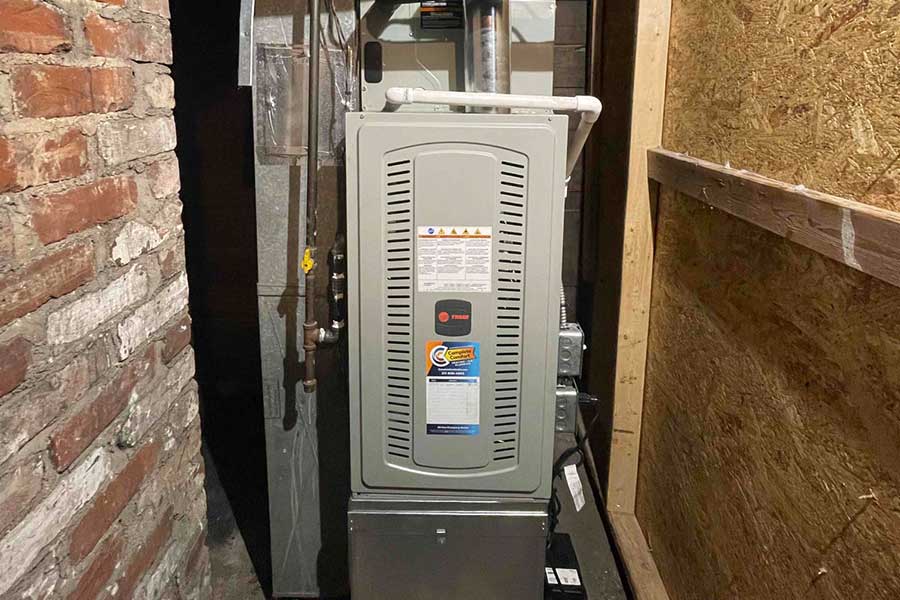
We got a call from a homeowner named Karen on a Friday evening in December after her furnace had been gradually losing heating effectiveness over the previous two months. The home was comfortable but not as warm as the thermostat suggested it should be, and her gas bill had crept up steadily since October. The furnace was thirteen years old and had received a filter change annually but no professional service since installation.
Our technician found the secondary heat exchanger passages significantly scaled from thirteen years of hard Hendricks County water running through the condensate circuit without descaling. The restriction was reducing the exchanger’s ability to extract heat from the exhaust stream, dropping effective efficiency well below the system’s rated output. The condensate trap itself was partially restricted, and the pressure switch was reading marginally, close enough to trip under certain conditions without having done so yet. We descaled the heat exchanger passages, cleaned and flushed the condensate trap, and verified pressure switch operation post-cleaning. Karen’s gas bills dropped noticeably the following month, and the heat output she had been slowly losing over two seasons returned. Thirteen years of hard water accumulation reversed in a single service visit.
Plainfield homeowners invest in their homes and expect their service providers to show the same care. We bring that to every furnace call in Hendricks County. Here is what you get from our team.
We are committed to Plainfield homeowners and to the honest, thorough work that makes every repair worth the call.
Yes, in high-efficiency furnaces. The condensate produced by these systems carries dissolved minerals that deposit scale in the secondary heat exchanger passages and condensate trap over time. As scale accumulates, it insulates the exchanger surface and restricts condensate flow, both of which reduce the system’s ability to extract heat from exhaust gases. The efficiency loss is gradual but measurable, and it shows up on heating bills before it triggers operational failures.
Annual service is the standard recommendation everywhere, but in hard water areas like Hendricks County it is particularly important for high-efficiency systems. The condensate pathway and secondary heat exchanger benefit from annual inspection and cleaning to prevent the scale accumulation that annual service removes before it reaches a level that affects performance or triggers lockouts.
The condensate trap is a small U-shaped or cup-shaped component in the condensate drainage path that holds a water seal to prevent flue gases from traveling backward through the drain line. It is typically located near the base of the furnace or in the drain line between the furnace and the floor drain. In high-efficiency systems, it is one of the maintenance items that should be cleaned annually because it is the point most susceptible to scale and biological accumulation.
Yes. Variable-speed motors typically degrade progressively rather than failing abruptly. A failing capacitor causes the motor to draw excess current and run at reduced efficiency, which may appear as slightly uneven heat distribution, longer run cycles, or higher-than-expected energy use before any obvious malfunction occurs. A technician can test capacitor condition and motor current draw to identify gradual degradation before it progresses to failure.
The most impactful DIY maintenance is consistent filter replacement, typically monthly during heavy heating season use, and keeping the area around the furnace clear of stored items that can restrict airflow or create a fire hazard. Checking that the condensate drain outlet is flowing freely and not backed up is also worthwhile. Everything beyond those basic checks, including combustion safety assessment and condensate system cleaning, should be handled by a licensed technician.