


Pipe Replacement & Installation in Greenwood, IN
- 24/7 Service
- Quality Focused
- Highly Trained
- Unmatched Customer Service
- 24/7 Service
- Quality Focused
- Highly Trained
- Unmatched Customer Service
What Your Neighbors Are Saying About Us
Contact Us
Most homeowners never think about their water lines until something fails. A pinhole leak behind drywall, water pressure that keeps dropping, or a line that freezes every January is usually the point where the conversation starts.
Greenwood homes face a specific set of challenges. Hard water leaves mineral scale inside supply lines, clay-heavy soil shifts with every freeze-and-thaw cycle, and plenty of houses in and around Old Town Greenwood still have galvanized steel or early-generation plastic that has outlived its design life. Complete Comfort Heating, A/C & Plumbing Repair handles pipe replacement in Greenwood, IN, from a single-problem run to a full repipe, and we’ll honestly tell you which one you actually need.
Our Services:
- Commercial Plumbing
- Drain Cleaning
- Drain Pipe Repair
- Faucets
- Garbage Disposals
- Gas Lines
- Hydrojetting Drain Cleaning
- Plumbing Maintenance
- Plumbing Repair
- Rooter Services
- Shower & Bathtub Installation
- Sewer Pipe Repair
- Sewer Services
- Sump Pumps
- Toilets
- Trenchless Sewer
- Water Heater Services
- Water Heater Repair
- Water Heater Replacement
- Tankless Water Heaters
- Water Treatment
Is It Time to Replace Your Home's Pipes?
Piping rarely fails all at once. These signs point toward replacement rather than another patch:
- Repeat leaks in one area
- Rusty or discolored water
- Low pressure throughout the house
- Visible corrosion on the exposed pipe
- Galvanized steel supply lines
- Water that smells metallic
- Pipes older than 50 years
- Frequent winter freeze-ups
One leak is a repair. A pattern of leaks means the material itself is giving out, and chasing each one costs more over time than replacing the run.
Problems Caused by Old, Corroded, or Damaged Piping
Corrosion works from the inside out. Galvanized steel builds a layer of rust and scale that narrows the opening until flow drops to a trickle, and that same debris ends up in your faucet aerators, washing machine valves, and water heater. Greenwood’s hard water speeds the process along by adding mineral deposits on top of the rust.
Leaks are the costlier problem. A pinhole inside a wall or above a finished ceiling can run for weeks before you notice a stain, and by then, you are dealing with soaked insulation, warped flooring, and mold in the cavity. Slab leaks are worse, since the water has nowhere to go but under your foundation.
There is also the pressure side of things. A weak or brittle pipe cannot handle the pressure spikes that happen when a valve slams shut, which is why aging systems tend to fail during routine use rather than during anything dramatic. Winters here make it worse, because any uninsulated run in a crawlspace or along an exterior wall is a freeze risk that an already weakened pipe may not withstand.

Choosing the Right Pipe Material for Your Home
PEX has become the common choice for residential supply lines, and for good reason. It flexes rather than splits under freeze stress, resists scale buildup caused by hard water, and installs with fewer fittings, which means fewer potential leak points inside walls. It also runs in continuous lengths, so a repipe disturbs less drywall.
Copper remains a solid option and still has a place. It handles heat well, withstands UV exposure where lines run exposed, and has a long track record. The trade-offs are cost and the risk of developing pinholes over time under certain water conditions.
For drain, waste, and vent work, PVC and ABS are standard. Both are durable underground and resist the corrosion that eats cast iron from the inside. If you are replacing cast-iron drains in an older Greenwood home, this is usually where we go.
We walk you through the options for any pipe installation in Greenwood, IN, based on your water quality, home layout, and budget. There is no single right answer for every house, and we are not going to push the most expensive material when a better-suited one costs less.
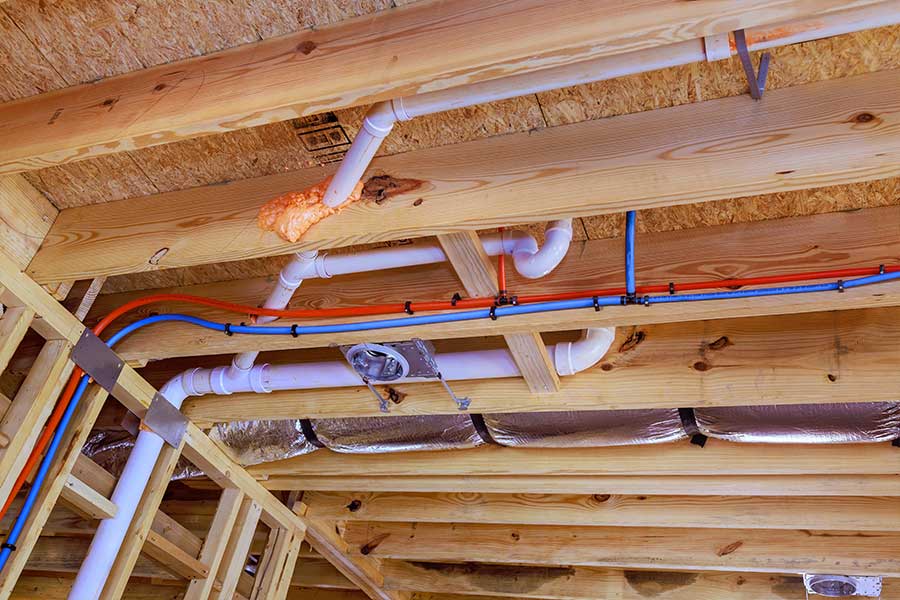
Our Pipe Replacement & Installation Process
We start by mapping your system. That means locating your main shutoff, identifying every material in the house, checking static pressure, and finding where the problem actually is. Older homes often have a mix of materials from different decades, and knowing that upfront prevents surprises mid-job.
Then we give you a written scope and price before any work begins. You will know what is being replaced, what stays, how much drywall will be removed, and how long your water will be off. If a phased approach makes more sense than doing everything at once, we will say so.
Installation follows. We open access only where needed, pull new lines, and make connections with the proper fittings and supports for the material we use. Where lines pass through unconditioned space, we insulate them, because an uninsulated run in a Greenwood crawlspace is a freeze waiting to happen.
We finish by pressure testing the system, flushing the lines, and checking every fixture for flow and leaks. Then we walk the job with you, show you the new shutoffs, and explain anything you should keep an eye on.

Why Choose Complete Comfort
- Available 24/7 for emergencies
- Expertly trained plumbing technicians
- Upfront pricing, no surprises
- Financing and maintenance plans
- Clear updates throughout the job
- Done right the first time
Complete comfort in every way is more than a slogan here. It is how we approach work that disappears behind your walls.
Frequently Asked Questions
How long does a whole-house repipe take?
Most homes take two to four days, depending on size and access. We give you a realistic timeline and tell you exactly when water will be shut off.
Do you have to tear out all my drywall?
No. We open targeted access points rather than full walls, and we plan the routing to minimize the number of openings.
Is PEX better than copper?
For most Greenwood homes, yes. PEX handles freezing better and resists hard water scale, though copper is still a good fit in certain situations.
How much does pipe replacement cost?
It depends on your home’s size, pipe material, and access. We provide a written price before we start, so there are no surprises.
Can I replace just one section instead of everything?
Often yes. If the rest of your system is sound, a targeted replacement makes sense. We will show you what we found and let you decide.
