
We're Hiring!



Whiteland is a small Johnson County community where homeowners take care of their properties and expect the same from anyone they let through the door. Most homes here were built between the 1970s and 1990s, and the furnaces inside them have reached the age where the question is no longer whether they will need attention but what kind of attention they will need and when. Complete Comfort Heating, Air & Plumbing serves Whiteland with the honest, capable furnace repair that fits a community like this: no inflated recommendations, no unnecessary parts, just accurate diagnostics and quality work.
We are available 24/7 for furnace emergencies throughout Johnson County because cold winter nights in Whiteland do not favor waiting until morning.
Whiteland’s housing stock from the 1970s through 1990s puts most local furnaces in a position where original or early-replacement systems are approaching or past their reliable service window. These warning signs in that age of home deserve a call rather than a reset and a hope for the best.
In a community where many homes have been in the same family for decades, these symptoms in an older furnace are often recognized as patterns that have been building for a while. Acting on them while a repair is still viable is always the better path than waiting for a complete failure.
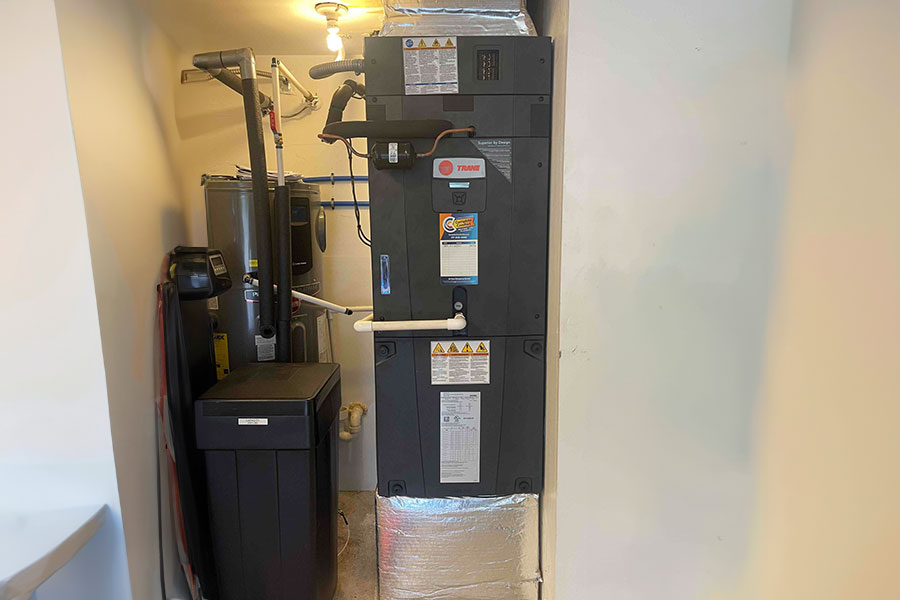

Johnson County’s southern position within the Indianapolis metro puts Whiteland in a zone where winter weather systems have already deposited their heaviest snowfall and coldest air by the time they arrive from the northwest, but sustained cold is still fully characteristic of the local climate. For Whiteland furnaces, the more significant environmental factor is the soil and groundwater moisture conditions that affect basement mechanical spaces. Johnson County’s poorly draining glacial till soils keep moisture levels elevated around and beneath older foundations, contributing to the basement humidity that accelerates corrosion on burner assemblies, heat exchangers, and flue metal in homes that lack effective vapor control in the crawl space or basement.
The era of construction common to Whiteland’s housing stock also matters. Homes built in the 1970s and 1980s were constructed before the insulation standards and air sealing practices that became common in the 1990s and 2000s, which means they have higher heat loss rates and their furnaces run more hours per year to compensate. A furnace in one of Whiteland’s older homes may log fifty to seventy percent more annual runtime than a comparable unit in a newer, tighter home, compressing its component life in ways that make annual maintenance more impactful than the owner of a newer home might appreciate.
Complete Comfort handles furnace repairs throughout Whiteland and the surrounding Johnson County area, with technicians experienced in the mid-efficiency and early-generation high-efficiency systems that characterize this era of residential construction. We approach every call with a complete diagnostic that accounts for the home’s construction era and operating environment rather than treating all furnaces as equivalent regardless of context.
Our Whiteland repair services cover heat exchanger inspection and combustion safety analysis with CO testing, burner cleaning and corrosion assessment, ignition system repair across all configuration types, gas valve and manifold pressure testing, blower motor service including bearing condition and capacitor testing, inducer motor diagnostics, duct condition and airflow evaluation for older distribution systems, flue and venting integrity inspection, and control board diagnostics. Every finding is communicated clearly and pricing is confirmed before any work begins.
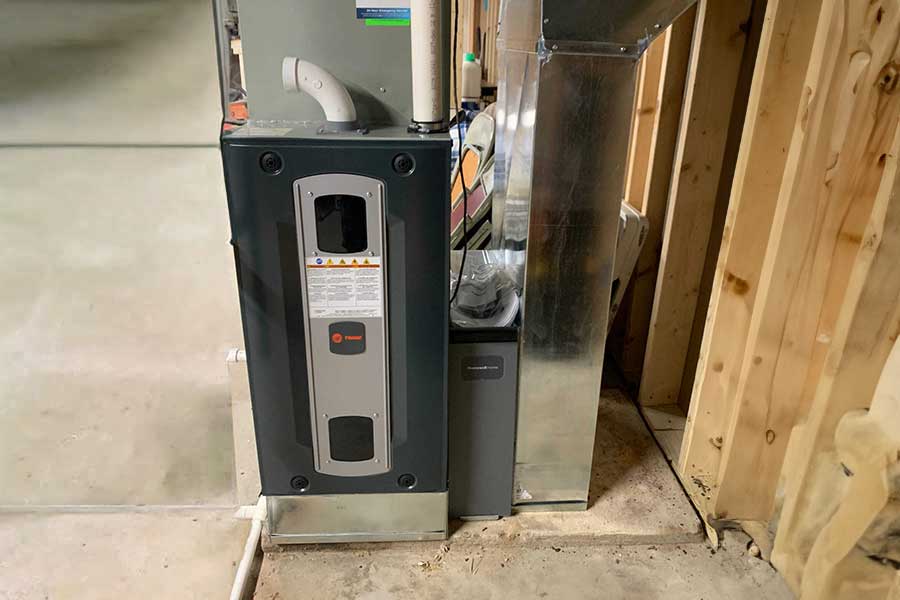
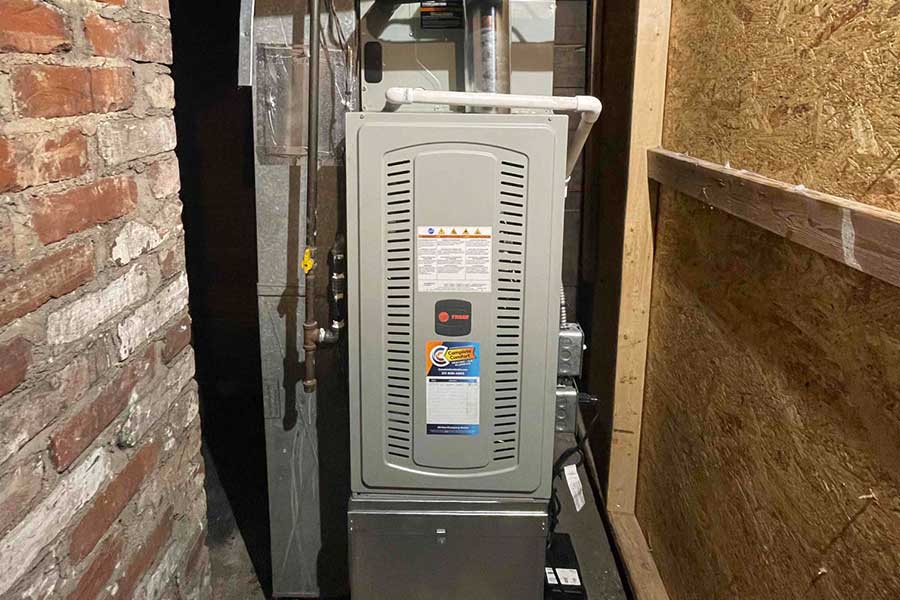
We received a call from a homeowner named Jim on a Tuesday morning in January after his furnace had been struggling visibly for several days during a prolonged cold stretch. The home was a 1978 ranch that had been in his family for decades, and the furnace was a replacement unit installed about sixteen years prior. The system was running frequently but the house was not getting above sixty-five degrees despite a thermostat setting of seventy-two.
Our technician ran a full diagnostic and found corroded burner ports reducing combustion efficiency, consistent with years of operating in a basement with measurable humidity. The combustion analysis also showed the system’s efficiency had degraded significantly from its rated output, not from a single failed component but from the cumulative effect of corrosion and wear across multiple burner and heat exchanger surfaces. A static pressure check also revealed a partially collapsed flex duct section in the basement ceiling where an older return air run had developed a restriction, forcing the blower to work harder and deliver less air than the system required. We cleaned the burners, corrected the duct restriction, and ran a full post-service combustion analysis. The improvement in heat output was immediate and Jim noticed it the same afternoon. Two separate issues working together had produced a deficit that neither alone would have caused to the same degree.
Whiteland homeowners want a furnace company that respects their home and gives them honest answers. We bring that to every call in Johnson County. Here is what you can count on from Complete Comfort.
We take pride in the work we do in Whiteland and in every Johnson County home we enter, and we stand behind every repair we complete.
A home with poor insulation and significant air infiltration forces the furnace to run more hours per year to maintain the same interior temperature compared to a well-sealed newer home. More runtime means more thermal cycles on the heat exchanger, more hours on blower motor bearings, and faster accumulation of combustion deposits on burner components. Annual service is more impactful in a high-runtime home than in one with lower heating demand.
Yes. Partially corroded or scaled burner ports restrict and distort gas flow across the burner assembly, leading to uneven flame patterns and incomplete combustion without causing the furnace to shut down or produce obvious error codes. The result is reduced heating output and lower efficiency that builds gradually over multiple seasons, often noticed as rising utility bills or a furnace that runs longer before feeling effective.
Static pressure is the resistance the blower motor works against when pushing air through the duct system. A collapsed or kinked flex duct creates a partial obstruction that increases resistance, forcing the blower to work harder while delivering less air. High static pressure reduces airflow to all registers served by the affected run, increases blower motor wear, and can contribute to the heat exchanger overheating and tripping the high-limit safety switch.
It depends on the nature and cost of the repair and the overall condition of the system. A minor repair on a sixteen-year-old furnace with a sound heat exchanger and reasonable efficiency may be worth doing, particularly if the homeowner is not ready to invest in replacement. If the heat exchanger shows stress, the efficiency has degraded significantly, or the repair cost is substantial, the calculus shifts toward replacement. A technician can walk through the tradeoffs honestly.
Functioning carbon monoxide detectors in the home provide the most important safety monitoring available between professional visits. Beyond that, a flame that burns steady and blue, no exhaust smell from supply vents, and no CO detector activations are all positive indicators. However, heat exchanger integrity cannot be assessed without physical inspection and combustion analysis. Annual professional inspection remains the only way to reliably evaluate combustion safety in an aging furnace.